
Prison ministry, I’ve discovered, provides a sure-fire cure for blindness. (But it’s perhaps not always as effective in remedying other physical or spiritual defects.)
Just a couple of weeks ago, I received my latest installment of God’s healing grace … when I was seated at table next to a guy who was wrapping up his 18th year of incarceration at Menard. That’s the second half of his story. The first half, the first 18 years, had been spent in a succession of placements in less-than-loving foster homes.
I gotta tell you, hearing his story caused something like scales to fall from my eyes: All of a sudden, I was able to see that not everyone grows up with the same blessings I’ve been given throughout my life. His wounds, in a sense, helped to heal me of my blindness.
And under the circumstances, then, I probably shouldn’t have been surprised to hear this guy’s response … when the question was posed to us: “Who is God for you?”
“I think it’s all a myth,” he replied. Brutal and succinct, just like the circumstances of his life.
I was dumbstruck in that moment. I had no words to share, no comfort to offer – nothing to counter the harsh reality of a society that had failed this man. Nor any effective way to witness to an allegedly-loving God who had apparently (and consistently) abandoned him for 36 years.
Of course, words are cheap. And perhaps that’s why Jesus chooses to wash his disciples’ feet. He doesn’t just talk about God’s love. He shows them how he’s willing to empty himself of dignity. How he’s willing to connect with them on their level. As low as they might feel, he’s willing to go lower still … as proof of his desire for intimate communion with them.
Four decades of gang intervention work in LA have opened Greg Boyle’s eyes to a similar insight. The Jesuit priest* observes, “[Either] Risen Life is meaningful now, or it’s not meaningful at all… We really can live in the forever. [But] how do we do that? How do we receive the tender glance from God, and then choose to be that tender glance for others?”
Surely, the Eucharist is one way to notice God’s glance. When I manage to pay attention, I see in Holy Communion a God who desires to be close to me. Eucharistically close, a simple disc of unleavened bread – now transubstantiated – and now to be savored on my tongue or cradled in the palm of my hand.
But the Body of Christ ought not stay there. It (He) must be shared, even in those circumstances where words fail me. In those settings where transubstantiation might be dismissed as “myth.”
As it happens, I did not have Communion bread to share with my guy on the Kairos retreat. But I did have cookies, supplied by the Body of Christ. I had Christian fellowship, too. And wonder of wonders, I think my guy noticed.
“Yo, this Kairos is dope!” he reported to the crowd at one point in our time together. “There are actually some decent individuals here.” (By ‘dope!’, I’m pretty sure he meant ‘excellent!’).
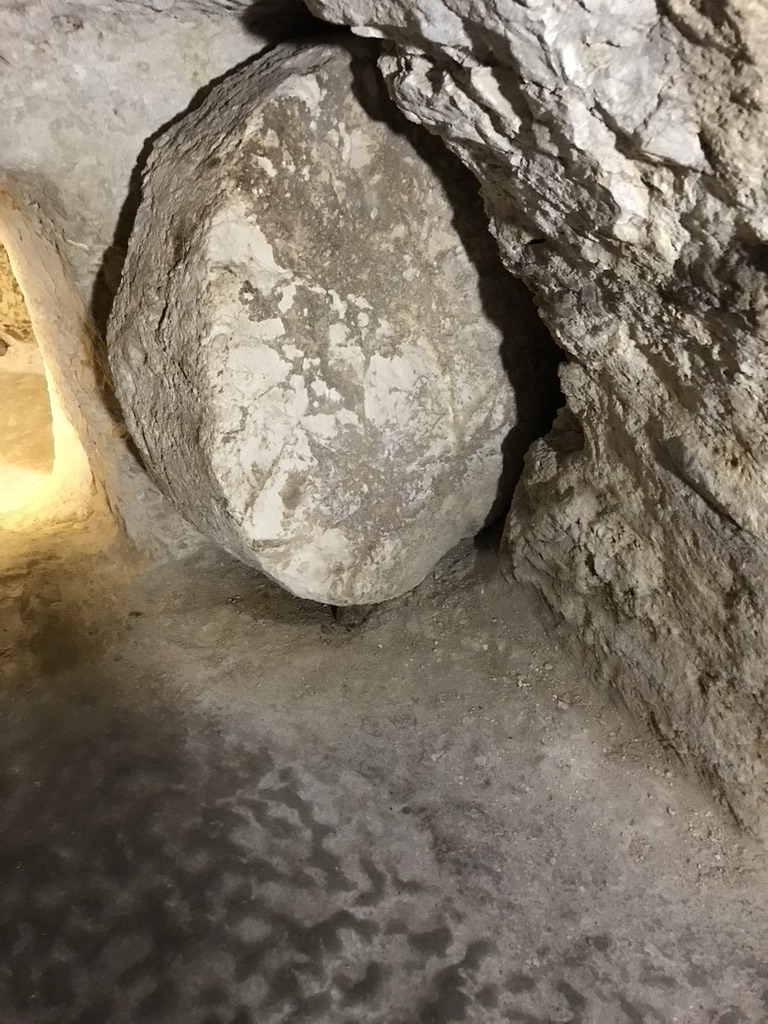
Yes, Christ tends to go low, we are reminded on Holy Thursday. It’s his power move, one we are called to imitate. And perhaps there’s a reason for this. Maybe “going low” provides just the leverage required to reach a broken heart, to begin rolling away the stone.
Let us pause now…to recall that we are in the presence of the Holy & Merciful One.
IHS
*You can hear Fr. Boyle’s wonderful Easter homily here.


 With Us Still