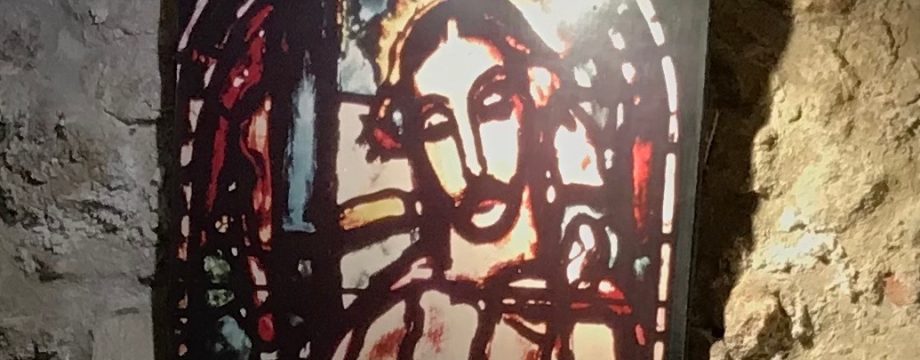
You’re welcome, folks.
(And “thanks,” Charles Taylor.)
In recent days, I finished reading Taylor’s book A Secular Age. It’s a massive tome, running to 776 pages. (Its footnotes alone total more than 170 pages – more or less equaling the length of book I’m typically inclined to read these days.)
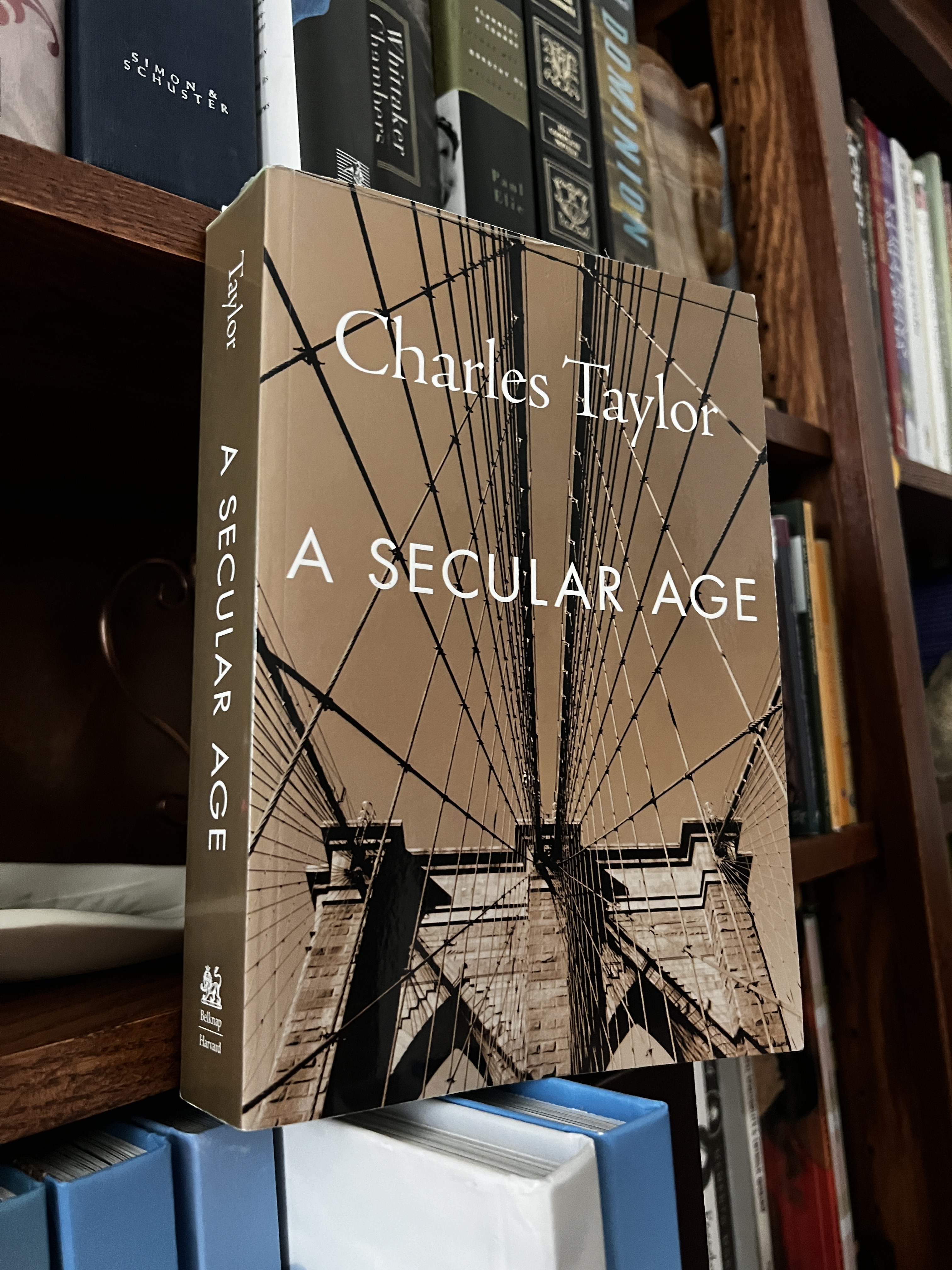
But I slogged through all of it — every page of A Secular Age.
I did it for you, Dear Reader, so you wouldn’t have to. At least, that’s what I kept telling myself as my weeks of reading…stretched into months…then a year…and still more days and weeks and months after that.
Ok, to be honest, I didn’t read A Secular Age only for you. Probably not even mostly for you. But perhaps, like me, you’ve lived long enough to notice (and even be puzzled by) a definitive shift in our culture – one that leans heavily into science. Into data. Into algorithms. Into reason.
All of that tends to come at the expense of mysticism and wonder, it seems to me. Not to mention, at the expense of religious practice. As a people, we just don’t seem to have much interest in things we cannot commoditize or consume for our own enjoyment. Our work-weeks are devoted to “maximizing the customer experience”…our weekends, to binge-watching TV or to tailgating, football and other frivolities.
We live, in short, in a secular age. So I kept on reading because I thought it might be interesting to learn Charles Taylor’s take on how we got here. While his insights defy simple summarization, they involve a complicated brew of philosophy, sociology, politics, religion and astrophysics, among other disciplines. Taylor cites dozens of authors – some names I recognized, such as Plato, Aristotle, Aquinas, Kant, Hume, Rousseau, Voltaire, Nietzsche, Hegel, Girard, Heidegger; and many more thinkers who were new to me: Durkheim, Bosseut, Condillac, Herder, Fukuyama, Helvetius, Höderlin, Péguy, Trevelyan, Tindal, among others.
Given that prodigious line-up of thinkers, I’m sure you can appreciate how my “reading” of A Secular Age tended to devolve into a “slog” on many occasions. I’m not entirely sure why I was determined to push through to the end. But having reached the end, I was delighted to discover Charles Taylor looking at me, and at us, as he unpacked an eternal mystery.
“None of us could ever grasp alone everything that is involved in our alienation from God and his action to bring us back,” he writes. “But there are a great many of us, scattered through history, who have had some powerful sense of some facet of this drama.” [p. 754]
I thought about the author of the Letter to the Hebrews when I read Taylor’s observation, because we encounter just such a facet in the first reading proclaimed on the first weekday in Ordinary Time:
In times past, God spoke in partial and various ways to our ancestors through the prophets; in these last days, he spoke to us through the Son, whom he made heir of all things and through whom he created the universe…
Heady stuff here, asserted by that first-century writer. But powerful as it is, his insight doesn’t answer every question about God, does it?
Fittingly, a bit further on in his conclusion, Taylor mentions the role that all writers play in this unpacking process:
…the end of writing is to reach others and to effect a coming together in the Being revealed…[to] unlock meaning in the chain of meanings… [p. 760]
Imagine that: This “end of writing,” described at the end of Taylor’s VERY long book, seems to capture precisely what I hope to be about…as I write each week in my silly little blog. Taylor and I both want to help you see what we see, even as we peer through the disorienting fog of a secular age.
God is there.
God is there, still being revealed in partial and various ways (even through the humble blog post.)
God is there, and far from finished in this work of drawing all of humankind back into a fruitful and creative relationship with the Holy One.
Let us pause now…to recall that we are in the presence of the Holy & Merciful One.
IHS


 With Us Still